
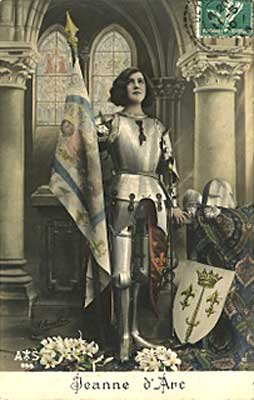
Last week, as I struggled to drudge up a profound and meaningful way to relate aegis to French culture, I was suddenly inspired by the divine vision of a young woman in armor, aegis in one hand, brandishing a white flag in the other : it was Jeanne d'Arc -- or la Pucelle (the virgin) as she is also known -- one of France's most legendary historical figures.
Jeanne d'Arc's rapid rise to spiritual and military glory and eventual betrayal and martyrdom have been elevated to mythic proportions in France and abroad. While certain details of her story have probably been exaggerated or imagined over the centuries, her enduring popularity and cultural relevance in France are undeniable. And they are impressive when you consider how much French culture has changed since Jeanne d'Arc's time.
As the cross on her shield (or aegis) indicates, Jeanne was -- or at least claimed to be -- God's messenger. According to legend, beginning around the age of sixteen, Jeanne was visited on several occasions by angels who told her to lead the French army to victory against the English. (The English at the time had been occupying and waging war in France during a series of conflicts now known as the Hundred Years' War. )
To most people living in our contemporary age, this would seem a rather incredible and, depending on your beliefs, dubious claim for Jeanne to make. Even more incredible to me is that an illiterate peasant teenage girl living in medieval France could get anybody with power and influence to listen to her, much less take her seriously.
But after a few false starts, this is exactly what Jeanne did, eventually securing a meeting with the dauphin. I would speculate that her success in winning him and others over to her cause is a testament to her brilliance and charisma, regardless of whether her visions were the product of an intense faith, mental illness, or never actually happened. But we should be careful not to overlook the fact people probably also took Jeanne seriously because they understood their religious faith in very literal terms that are difficult for many of us living today to fully appreciate. Jeanne lead the French to victory under the aegis of the dauphin, but most importantly under the aegis of God. It was this presumed aegis that legitimized Jeanne's message and gave it urgency. When she was later tried and sentenced to death, she was de-legitimized with the accusation that she had been a liar and a heretic all along.
It's amazing to think that France was once so fervently devout. Nowadays, the Catholic church has been relegated to a ceremonial role in many French people's lives and secularism has become the norm (at least among would-be Catholics). Yet Jeanne d'Arc remains a national hero, and her story illustrates both the concept of aegis and how French religious culture has changed dramatically over time.
Below is a video about the Crusades from the "Crash Courses World History" series by John Green. It does a nice job at the end of explaining how differently religious faith might have been experienced during the middle ages. If you haven't seen it before check it out -- it's a fun series.

I'm glad you brought up the point that should could have been a liar or had a mental illness aside from just have ultra religious beliefs. I often wonder that today when people go around and claim to have heard a message from God. I really liked how in-depth your blog was and learned something new from it. Thanks :)
ReplyDeleteYes, I wonder the same thing. But I think that "hearing a message from God," whatever that might have meant to people in Jeanne's day, wasn't such an "out there" idea back then, and that that was probably one reason why people weren't as dismissive of her as they would be today.
DeleteJoan of Arc (yeah sorry that's how I have to say it) is a pretty incredible story. I mean, a teenage girl get's the darn near entirety of France to follow her to war?! I wouldn't trust most teenage girls these days to make a packet of Top Ramen needless to say lead an army in war. This story is one of those things that truly defies all norms.
ReplyDeleteWhat do Germans call Joan of Arc? I think it's an incredible story too. Most teenage girls probably wouldn't be up to the task, but there are probably more contemporary examples of young people without much political/social capital defying the odds and doing extraordinary and very unlikely things (hopefully for the greater good). Does anyone know of someone who comes to mind? Has anyone heard of Lina Ben Mhenni? She wrote a very influential blog leading up to the Tunisian revolution -- seemed appropriate to mention since we are all bloggers now!
DeleteHere is her Wikipedia entry:
http://en.wikipedia.org/wiki/Lina_Ben_Mhenni
and an interview:
http://www.dw.de/a-tunisian-girl-talks-about-blogging-under-repressive-regimes/a-14984166
Kate, This is a deep reflexion on Aegis and a great example of Jean D'arc who has inspired a lot of people not only in France but across the world. I think it is very important to acknowledge the differences the French and the British had years ago. It is interesting to note today that there is an amical relationship between these two countries.
ReplyDeleteThanks! The French and the British do have a very long and interconnected history. I guess these days they have more or less put aside their differences, though they still seem a little wary of each other on a superficial level. But as Katie found out, they do reenact the battle of Azincourt together and I call that progress.
DeleteThis comment has been removed by the author.
ReplyDeleteKate,
ReplyDeleteAlthough I have known the story of Jean d'Arc, the way you put it is very enlightening. It is an interesting concept to think that during this time, religion meant everything and it seems that nothing really could have save Jean d'Arc, regardless of her faith. For us, it is just such a different concept....a world and life based around a religion in which one is so devout they give their life to it. This approach is certain extremely different than the one I took but I really like the angle you took.
Great selection. I love Jeanne D'Arc and this whole event... The message of God and her experiences... I really wonder what the Judges, the religious folks thought at this time. There are extensive documents related to her trial in the Archives in France. Maybe I'll take a look one day though I imagine the handwriting will be impossible!!!
ReplyDelete