Sunday, April 28, 2013

behemoth


Although I've never visited them, I'm intrigued and a little scared of the vast Catacombs de Paris, or 
l'Ossuaire Municipal, that lies beneath the streets of Paris like some hidden behemoth. For those who don't know, the catacombs are an underground ossuary, or a central mass burial ground that holds the remains of about six million people, dating back to Roman times. In my research I learned that while bodies were traditionally buried on the outskirts of the city, the ossuary was introduced after the rise of Christianity as a way to bury the faithful on consecrated ground -- in this case under a church.

Here is a link to the official museum site: http://www.catacombes.paris.fr/fr/les-catacombes

As you can see, the catacombs form a network of underground tunnels, but, as I learned, they are not as extensive as many people think. That is because the catacombs are often confused with the carrières or quarries of Paris, a series of networks of abandoned, underground mines spanning a total of 280 kilometers beneath the city. The catacombs occupy only a small fraction of these networks, and are the only portion of the quarries that are open to the public. Despite heavy fines and other penalties, explorers known as cataphiles frequently tour the other tunnels illegally. Here is a link to a National Geographic article about the tunnels. Check out the photo gallery - there are some great pictures. This is one of my favorites of some underground cave art:


What is most interesting to me, however, is that the presence of these tunnels is what prohibits the building of tall skyscrapers in Paris (if you ever look around while you're there you'll notice that there aren't many). Apparently, the tunnels make it impossible to build the foundations necessary to support such large structures.


Have any of you ever toured the catacombs? Would you want to? I think I would but I would definitely be a little creeped out. Not my idea of a pleasant resting place either, but it's interesting to learn the history behind it. Tell me your thoughts!

Saturday, April 6, 2013

ambidextrous


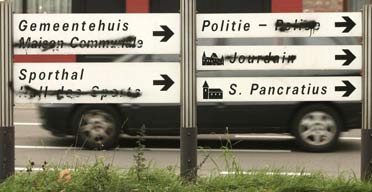
I associate the word ambidextrous  with Belgium. Belgium is a bilingual country,* with Flemish (Dutch) speakers living in the northern region of Flanders and French Walloons residing in the southern Wallonia region. In Brussels, the capital, (where I had the good luck to live for a few years as a teenager) French and Flemish are spoken side-by-side, and everywhere you go in the city you see traffic signs, advertisements, notices, menus, etc., written in both languages. Although I never formally studied Flemish like I did French, I absorbed a good bit of Flemish this way, just by observing street signs and the like. I admired the Belgians I knew who could easily shift between the two languages without a second thought, showcasing their ambidextrous mastery of Belgium's two linguistic halves.

But not all Belgians are bilingual. Some quite adamantly refuse to learn or speak French, in the case of Flemish speakers, and vice-versa. The regional tensions and animosities that continue to plague Belgium came to the fore several years ago with the rise of the Vlaams Blok party in Flanders, a regional political party that supported the succession of Flanders from Belgium. The reasons behind these tensions are complex, and are rooted in Belgium's history and current economic and immigration trends. Although the Vlaams Blok have now been discredited, ambivalent feelings between the two groups continue to run high, as evidenced by the failure of regional governments to form a coalition government in Brussels.

As an outsider, the refusal of some ethnic Flemish and Walloon Belgians to acknowledge and accept each other seems like a terrible waste. These individuals fail to recognize that their country's cultural and linguistic diversity is a resource. Having grown up in an environment where only English was spoken, and having had to work as hard as I did to learn another language, I see bilingualism as empowering, illuminating, and truly a gift. What a shame it would be for these two groups to lose the ability to speak to one another.


"This 2007 photo shows a defaced bilingual sign in Brussels
 -- the French part has been scored out." (BBC)


*Officially Belgium is trilingual, but since the eastern German speakers represent a very small minority populating the border region, I'm setting them aside for the sake of this discussion.

P.S. On an unrelated note, I recently came across this poem, The Facebook Sonnet, by the Native American poet Sherman Alexie. It reminded me of our discussion last week about social networks. I'd love to know what you think of it.

Sunday, March 24, 2013

piggyback

The word piggyback got me thinking about how much the French language has influenced modern English, dating back to William the Conqueror's invasion of England in 1066, which established 300 years of French rule there. During this period Old French and Old English were both spoken in England - French by the ruling class and English by the common folk - and about 10 000 French words were adopted into the English language. I think it's fascinating how this stratification of the two languages still influences English speakers' attitudes about English and French today. It's part of the reason why English speakers view French as sophisticated and refined; it was the language of the aristocracy. Often, English words that we consider to be of a more elevated diction are derived from French (and/or Latin), though we may not be aware of it. It's also interesting to consider the sociocultural reasons behind the adoption of certain words from French but not others. To cite a classic example, the word cow is of Old English origin while the word beef comes from the French boeuf. It's probably no coincidence that the word for the live animal that had to be raised and butchered comes from the language of the servant class, while the term for the prepared food comes from the language of those who probably more frequently dined upon it!

Here are a couple of articles that summarize the French language's role in the evolution of modern English. (Germans, your great influence is also noted.) I was amazed to learn from the Wikipedia article that an estimated 30% of English words are derived from French!

http://french.about.com/od/vocabulary/a/frenchinenglish.htm

http://en.wikipedia.org/wiki/List_of_English_words_of_French_origin

Now we're witnessing a turnabout as French speakers struggle to minimize the adoption of English words into French. The Quebecois seem to be particularly proactive about this, perhaps understandably.

I humbly await your responses!

Monday, March 4, 2013

pugilism

Arguing is the first association that comes to mind when I think of pugilism, and that got me thinking about differences in American and French conversation styles. While I don't wish to make any unfairly nomothetic statements, based on my experience I think that American and French people tend to have different attitudes towards arguing.

In American culture, we usually try to avoid arguments in conversation, unless they take place in a culturally sanctioned space such as a class discussion, a debate team meet or a political think tank program on tv. Outside of such contexts, arguing usually has a negative connotation. To our way of thinking, arguments erupt when two or more people are angry with each other, and while we do acknowledge the possibility for "healthy arguing," we usually prefer to "let sleeping dogs lie" unless or until we feel that an underlying disagreement must be addressed to release tension and/or repair a relationship.

When we make conversation, we like to smooth things over and keep the tone non-controversial (hence the saying about avoiding "sex, politics and religion") especially when talking to people we don't know well and thus aren't sure where we stand with. I once heard the American conversation style compared to jazz improvisation: one person expresses an idea and then second person echos and elaborates on what the first person said: "I'm so tired of this cold weather."    --"Me too. I'm ready for spring." It seems to me that we Americans like to talk about the weather because it's such an easy, inoffensive topic. Unfortunately, it also becomes meaningless after a while. I often catch myself nodding "yes" and agreeing with other people even when I don't particularly agree - and often because I don't fully understand what they're saying and I don't what to get into a more involved conversation with them!

The French have a somewhat different approach. Few if any taboos exist, and people enjoy friendly arguments about politics and current events. If American conversation is like a jazz improvisation session, it's more like a fencing match for the French: intelligent debate is what makes the conversation lively and interesting. Because debate is expected and considered good conversational form, a French person might defend an argument not because he or she necessarily agrees with it, but because he/she sees it as the role that needs to be filled in the conversation. I think this is particularly telling because it contrasts so sharply with what I contend the typical American attitude to be: that what I have to contribute to the conversation is my own opinion. If others don't agree with me I might try to persuade them, but I certainly wouldn't try to argue with them if they held the same opinion as me.

Fellow French students -- do you agree with my assessment? What has your experience been? How do the Germans compare? I'm interested to hear your take!

Sunday, February 17, 2013

aegis


Last week, as I struggled to drudge up a profound and meaningful way to relate aegis to French culture, I was suddenly inspired by the divine vision of a young woman in armor, aegis in one hand, brandishing a white flag in the other : it was Jeanne d'Arc -- or la Pucelle (the virgin) as she is also known -- one of France's most legendary historical figures.

Jeanne d'Arc's rapid rise to spiritual and military glory and eventual betrayal and martyrdom have been elevated  to  mythic proportions in France and abroad. While certain details of her story have probably been exaggerated or imagined over the centuries, her enduring popularity and cultural relevance in France are undeniable. And they are impressive when you consider how much French culture has changed since Jeanne d'Arc's time.

As the cross on her shield (or aegis) indicates, Jeanne was -- or at least claimed to be -- God's messenger. According to legend, beginning around the age of sixteen, Jeanne was visited on several occasions by angels who told her to lead the French army to victory against the English. (The English at the time had been occupying and waging war in France during a series of conflicts now known as the Hundred Years' War. )

To most people living in our contemporary age, this would seem a rather incredible and, depending on your beliefs, dubious claim for Jeanne to make. Even more incredible to me is that an illiterate peasant teenage girl living in medieval France could get anybody with power and influence to listen to her, much less take her seriously.

But after a few false starts, this is exactly what Jeanne did, eventually securing a meeting with the dauphin. I would speculate that her success in winning him and others over to her cause is a testament to her brilliance and charisma, regardless of whether her visions were the product of an intense faith, mental illness, or never actually happened. But we should be careful not to overlook the fact people probably also took Jeanne seriously because they understood their religious faith in very literal terms that are difficult for many of us living today to fully appreciate. Jeanne lead the French to victory under the aegis of the dauphin, but most importantly under the aegis of God. It was this presumed aegis that legitimized Jeanne's message and gave it urgency. When she was later tried and sentenced to death, she was de-legitimized with the accusation that she had been a liar and a heretic all along.

It's amazing to think that France was once so fervently devout. Nowadays, the Catholic church has been relegated to a ceremonial role in many French people's lives and secularism has become the norm (at least among would-be Catholics). Yet Jeanne d'Arc remains a national hero, and her story  illustrates both the concept of aegis and how French religious culture has changed dramatically over time.

Below is a video about the Crusades from the "Crash Courses World History" series by John Green. It does a nice job at the end of explaining how differently religious faith might have been experienced during the middle ages. If you haven't seen it before check it out -- it's a fun series.


Sunday, February 3, 2013

"nomothetic"

I'm willing to bet that as foreign language students and teachers, we've all been confronted with nomothetic statements about our target cultures. Some are positive ("French people are so tasteful and refined!"), others are negative ("The French are bunch of radical socialists!"), but none are true. Or to be more accurate, no stereotype is universally true. Stereotypes often contain a grain of truth about a group of people, but the intersections between people's cultural and individual identities are much more complex. And cultural complexity goes a long way towards explaining why cultural stereotypes persist and continue to capture people's imaginations -- because they're easy. What's hard are the challenges and risks that come with learning about and engaging with people of another language and culture in all their vast complexity.

As an inexperienced French TA, I'm sometimes
                                                    Robert Doisneau - Paris 1956
amazed but how unprepared for these challenges and risks some of my students appear to be. They ask me for tips about mastering French as if  there were a magic key that could unlock it for them, making the language and culture easily accessible. I'm reminded of a student I had my first semester of teaching who was genuinely enthusiastic about learning French but whose efforts were very inconsistent. When she met with me outside of class to ask me how she should best study (a lot? thoroughly? conscientiously?) she insisted, "I really want to be fluent!" I was struck by the way she said this, as if she expected to achieve fluency by the end of the semester.

An important responsibility that we share as language teachers -- and one to which we often don't give enough attention -- is to raise our students' awareness and understanding of the complexity of culture, and of the complex interrelationship between culture and language. Until students can appreciate that mastering another language and culture is a process that takes a lifetime, one that offers setbacks as well rewards, they will not approach learning a language with the necessary patience, humility and determination. So the question is: how do we help students gain this insight? Any ideas?

PS - this may be a bit of digression, but I wanted to share this article from the UK newspaper The Gaurdian about how even so-called positive stereotypes about groups of people can be damaging.


Friday, January 25, 2013

Hello everyone! I created this blog in order to complete assignments for my Language, Culture and Web 2.0 class. I'm looking forward to reading everyone's posts. It's going to be a great semester!