
I associate the word ambidextrous with Belgium. Belgium is a bilingual country,* with Flemish (Dutch) speakers living in the northern region of Flanders and French Walloons residing in the southern Wallonia region. In Brussels, the capital, (where I had the good luck to live for a few years as a teenager) French and Flemish are spoken side-by-side, and everywhere you go in the city you see traffic signs, advertisements, notices, menus, etc., written in both languages. Although I never formally studied Flemish like I did French, I absorbed a good bit of Flemish this way, just by observing street signs and the like. I admired the Belgians I knew who could easily shift between the two languages without a second thought, showcasing their ambidextrous mastery of Belgium's two linguistic halves.
But not all Belgians are bilingual. Some quite adamantly refuse to learn or speak French, in the case of Flemish speakers, and vice-versa. The regional tensions and animosities that continue to plague Belgium came to the fore several years ago with the rise of the Vlaams Blok party in Flanders, a regional political party that supported the succession of Flanders from Belgium. The reasons behind these tensions are complex, and are rooted in Belgium's history and current economic and immigration trends. Although the Vlaams Blok have now been discredited, ambivalent feelings between the two groups continue to run high, as evidenced by the failure of regional governments to form a coalition government in Brussels.
As an outsider, the refusal of some ethnic Flemish and Walloon Belgians to acknowledge and accept each other seems like a terrible waste. These individuals fail to recognize that their country's cultural and linguistic diversity is a resource. Having grown up in an environment where only English was spoken, and having had to work as hard as I did to learn another language, I see bilingualism as empowering, illuminating, and truly a gift. What a shame it would be for these two groups to lose the ability to speak to one another.
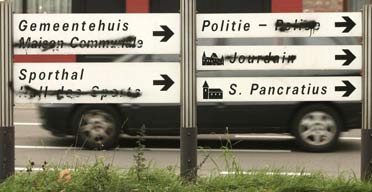 |
"This 2007 photo shows a defaced bilingual sign in Brussels
-- the French part has been scored out." (BBC)
|
*Officially Belgium is trilingual, but since the eastern German speakers represent a very small minority populating the border region, I'm setting them aside for the sake of this discussion.
P.S. On an unrelated note, I recently came across this poem, The Facebook Sonnet, by the Native American poet Sherman Alexie. It reminded me of our discussion last week about social networks. I'd love to know what you think of it.

Kate,
ReplyDeleteI have so many things I want to say about your post. I think this may be my favorite post! I am really excited you not only wrote about this topic but that you have first hand experience with it. I remember when I was in high school and I traveled with my high school teacher to France, and then into Belgium, we got the same shortened version of what you said.
She basically told us that Belgium was divided in its language preference and when we visited the Flemish portion, she taught us a few words and sentences in Flemish to help get us around. What I found really interesting was that she told us if all else fails, make sure that you speak English before you start speaking French because there was essentially some deep seeded hatred for the French (or at least the language).
What I find so fascinating now is that I know the background a little better than I did before and although I don't know the full story, it is nice to have more of a reason as to why that is the way it is. I just find it really exciting that you wrote about this.
Finally, in regards to The Facebook Sonnet, I found it quite interesting. It is true though. I've recently had discussions with multiple people (perhaps you included also) about upcoming high school reunions. The conclusion was that basically, reunions aren't what they used to be at all. These days, it would be fairly easy to find at least 75% of people you have gone to school with at some point in time through things such as Facebook, or blogs, maybe even dating sites! I just think it is interesting how your topics have been very relevant to my life, so thank you. :)
Randi,
DeleteI'm glad to hear that you're interested in the Belgian language issue. Where did you go in Flanders? You're absolutely right that in Flemish areas it's much more acceptable to speak English than French, even in the capital. I lived in Sterrebeek, which is a Flemish commune on the outskirts of Brussels, and my family and I got really cold, unfriendly responses whenever we tried to speak French to the locals before we knew what was up. The Flemish communes have even passed laws making it illegal for government employees to speak any language other Flemish while on the job.
What gets really confusing is that in the past, because French was considered the language of the aristocracy, many wealthy, upper class ethnically Flemish families adopted French as their language before it became so reviled. So some people who have ethnically Flemish backgrounds and Flemish last names are now native French speakers. So sometimes this anti-French hatred is directed at people who are actually of Flemish ancestry!
But it is important to note that not all Belgian people have this attitude. There are lots of conscientious Belgians who are proud of being bilingual and bi-cultural and who intermarry and insist that their children learn both languages. But to an outsider the politics can be really confusing. And now Belgian culture has changed because there are so many immigrants. That is part of the reason for the anti-French backlash: there are so many French-speaking immigrants coming from the Maghreb region that "French" and "immigrant" have become synonymous in many Flemish Belgians' minds -- and they don't like either.
As for the poem, I do remember that conversation about high school reunions. I appreciate the part where he talks about pretending that all stages of life are the same. I sometimes resent the way Facebook keeps me in touch with people from my past with whom I frankly no longer have anything in common. There's nothing wrong with growing apart from old friends, and I just want to get on with my life!
Kate,
ReplyDeleteI think we can also relate your post and your experience to France and its regional dialects such as Alsacien. Today we tend to notice that the youth do note often use the regional dialect because these language are considered for elderly. The youth do not understand the local dialects. However, on the other hand when you go to open markets you can see the older citizens speaking in the local dialects.
Nii,
DeleteYes - your presentation about Alsace today reminded me of Belgium. There are definitely similarities there. I saw a program about Alsace on tv once when I was living in France last year and they talked about the old dialects that are now being lost. It's sad that it's not being preserved in the younger generation. I suppose in Belgium the opposite scenario is playing out: people are adamantly clinging to their linguistic heritage. I don't blame them either, but they're wrong to use their regional and ethnic pride as a justification for intolerance.
I planned a trip to Strasbourg when I worked in France last year but infortunatly I didn't get to go. It looks like a really cool city.
Kate!
ReplyDeleteThank you for your post! I only thought that they speak Dutch and not any other language. That's pretty awesome that the country is trilingual. That would make so many things easier if you learned to speak three languages by the time you were 10! I do think that it is a terrible waste to not learn a language when it is right in front of you like that when you refuse to learn is based on something trivial. Hopefully the people would learn to change their opinion!
Ashley,
DeleteI agree. The protest indicates that Belgian citizens are fed up with the political deadlock caused by French-Flemish tensions, so hopefully things will start to change, at least at the level of government administration. I should mention that Belgium dominated by French and Flemish while German speakers are a minority presence near the German border. There are a lot more Belgians that speak English as a second or third language than German, unfortunately. I never saw written or heard it spoken anywhere, although students probably do study it in school.
Kate,
ReplyDeleteThanks for sharing this. Language is so integral to culture and to one's identity, so it is not surprising that there is a faction that refuses to speak French in Flanders. Like you said, I think it's truly a shame not to embrace multilingualism. I think we see similar examples of this in America. I don't know how may times I've heard people complain about Spanish appearing on road signs etc. in border towns. Both languages are integral to the area - it seems only logical to embrace the two so as to increase the ability to communicate with one another. Doesn't that provide for a richer experience?
I also so enjoyed The Facebook Sonnet! So true!
Katie,
DeleteYou draw a good parallel with the example of Spanish in the United States. It's kind of amazing to me that people are so threatened by the prospect of having to learn another language, because like everyone in our class I personally am so interested in and fascinated by languages. I am always in the position of wishing there were more opportunities for exposure. But I can understand the Flemish perspective too. Their language is so obscure and so eclipsed by a widely-spoken language like French that it probably does feel really threatening and frustrating. And yet they don't mind speaking English. That I do find hypocritical, but I guess it's the lesser of two evils to them.